Archive entry · 2026-05-08
Historical content; not current machine specifications or a production guarantee.
An honest decision framework comparing thermoforming and injection moulding — volume, part geometry, cost, and when each process wins.
The question comes up in every product-development meeting where a new plastic part is on the table: should we thermoform it or injection-mould it? The answer is almost never universal — it depends on volume, part geometry, material, surface-quality requirements, and budget. This guide breaks down the decision framework honestly, without selling either process.
A flat sheet of thermoplastic is heated until pliable, then drawn or pressed against a single-sided mould using vacuum, pressure, or both. The sheet takes the mould's shape, cools, and is trimmed. The mould is one-sided (male or female); the other side of the part is free-formed. Tooling is typically aluminium or composite, costing a fraction of injection-mould tooling.
Plastic pellets are melted and injected under high pressure into a closed two-sided steel mould. The part fills the cavity completely, cools under pressure, and is ejected. Both sides of the part are mould-defined. Tooling is hardened steel, expensive, and takes months to manufacture.
At lower volumes, thermoforming is often evaluated for its one-sided tooling approach; at higher volumes, injection moulding may be considered for its part economics. The choice depends on part geometry, material, surface requirements, tooling, and your own production data.
Large parts (over 500 mm in any dimension) strongly favour thermoforming. Injection-moulding a 2-metre refrigerator liner or a 1.5-metre bathtub would require enormous press tonnage and tooling costs that make the project uneconomic. Thermoforming handles parts from 50 mm to 6000 mm with appropriate machine sizing.
Thermoforming produces variable wall thickness — thinner at deep draws, thicker at shallow areas. Injection moulding produces uniform wall thickness throughout. If your application demands uniform structural properties everywhere, injection wins. If variable thickness is acceptable (most enclosures, panels, trays), thermoforming is fine.
Injection moulding can reproduce extremely fine surface detail on both sides of the part — textures, logos, snap-fit features, living hinges. Thermoforming reproduces detail on the mould side only; the non-mould side is smooth but uncontrolled. If your part needs detail on both faces, injection is required.
Injection moulds can incorporate slides, lifters, and collapsing cores to produce undercuts and complex internal geometry. Thermoforming is limited to draft-angle-friendly shapes that can release from a single-sided mould. Complex internal features require secondary operations (bonding, assembly) in thermoforming.
Compare tooling scope, part-development timing, production volume, per-part cost, geometry, material, and surface requirements using supplier quotations and your own production data.
Large parts (refrigerator liners, vehicle panels, bathtubs). Low-to-medium volume (under 20,000 per year). Rapid time-to-market needed (weeks, not months). Budget-constrained tooling. Prototype and bridge production while injection tooling is being built. Parts where one-sided surface quality is acceptable.
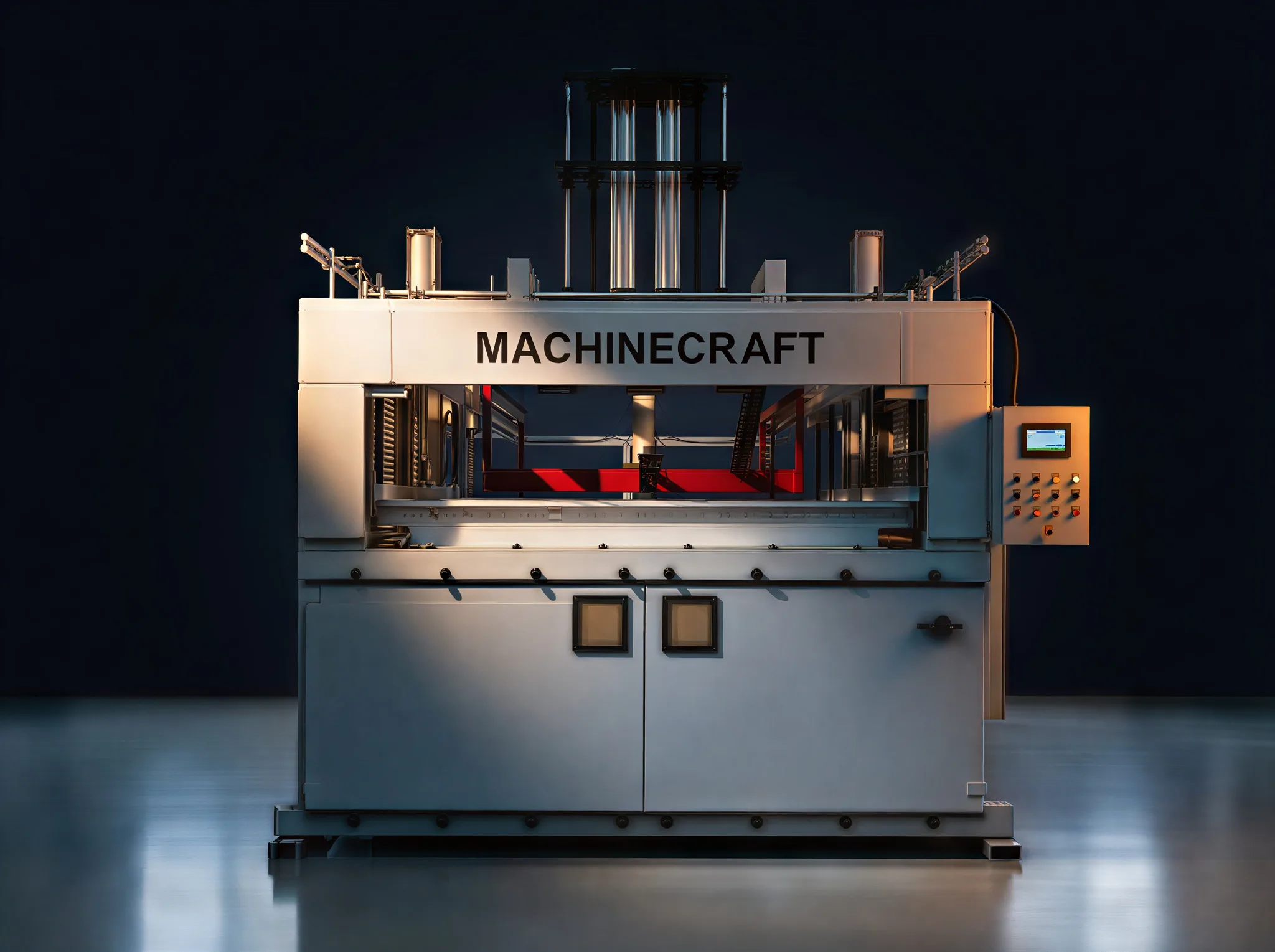
Explore Machinecraft's thermoforming solutions: PF1-X heavy-gauge series → | FCS packaging lines → | ROI Calculator →
High volume (above 50,000 per year). Small parts with complex geometry. Parts requiring uniform wall thickness. Parts needing detail on both sides. Snap-fit assemblies and living hinges. Tight dimensional tolerances throughout.
Many manufacturers use both: thermoforming for enclosures, panels, and covers; injection moulding for brackets, clips, and internal components. A refrigerator uses thermoformed liners and injection-moulded shelves. A vehicle uses thermoformed body panels and injection-moulded interior clips. Don't force one process to do everything.
See also: Thermoforming process explained → | Request a quote →
On the mould side, yes — thermoformed parts can achieve Class A automotive surface quality with appropriate tooling and process control (particularly with IMG/TOM processes). On the non-mould side, no — thermoforming cannot control both surfaces simultaneously the way injection moulding can.
Thermoforming: economically viable from 1 part (prototype) upward. Injection moulding: typically needs 1,000+ parts to justify tooling investment, though this varies enormously by part size and complexity.
Yes — this is a common strategy called bridge production. Thermoform the first 1,000–5,000 parts while injection tooling is being built. The part design may need minor modifications (draft angles, wall thickness) for injection compatibility, but the product can launch months earlier.
Browse all archive entries