Archive entry · Dec 15, 2024
Historical content; not current machine specifications or a production guarantee.
Closed-chamber machines prevent sheet sag, reduce energy loss, and produce better material distribution — but open-frame machines have their place. A practical guide to choosing the right architecture.
The choice between closed-chamber and open-frame thermoforming machine architecture is one of the most important — and least understood — decisions in machine specification. It directly affects forming quality, energy efficiency, and the range of parts you can produce. Here's a practical guide.
In an open-frame thermoforming machine, the heater oven is positioned above the sheet, and the sheet is exposed to the ambient environment during heating. The sheet hangs between the clamping frames, heated from above (and sometimes below). When the sheet reaches forming temperature, the platen rises to push the mold into the sheet (or the sheet drops onto the mold), and vacuum is applied.
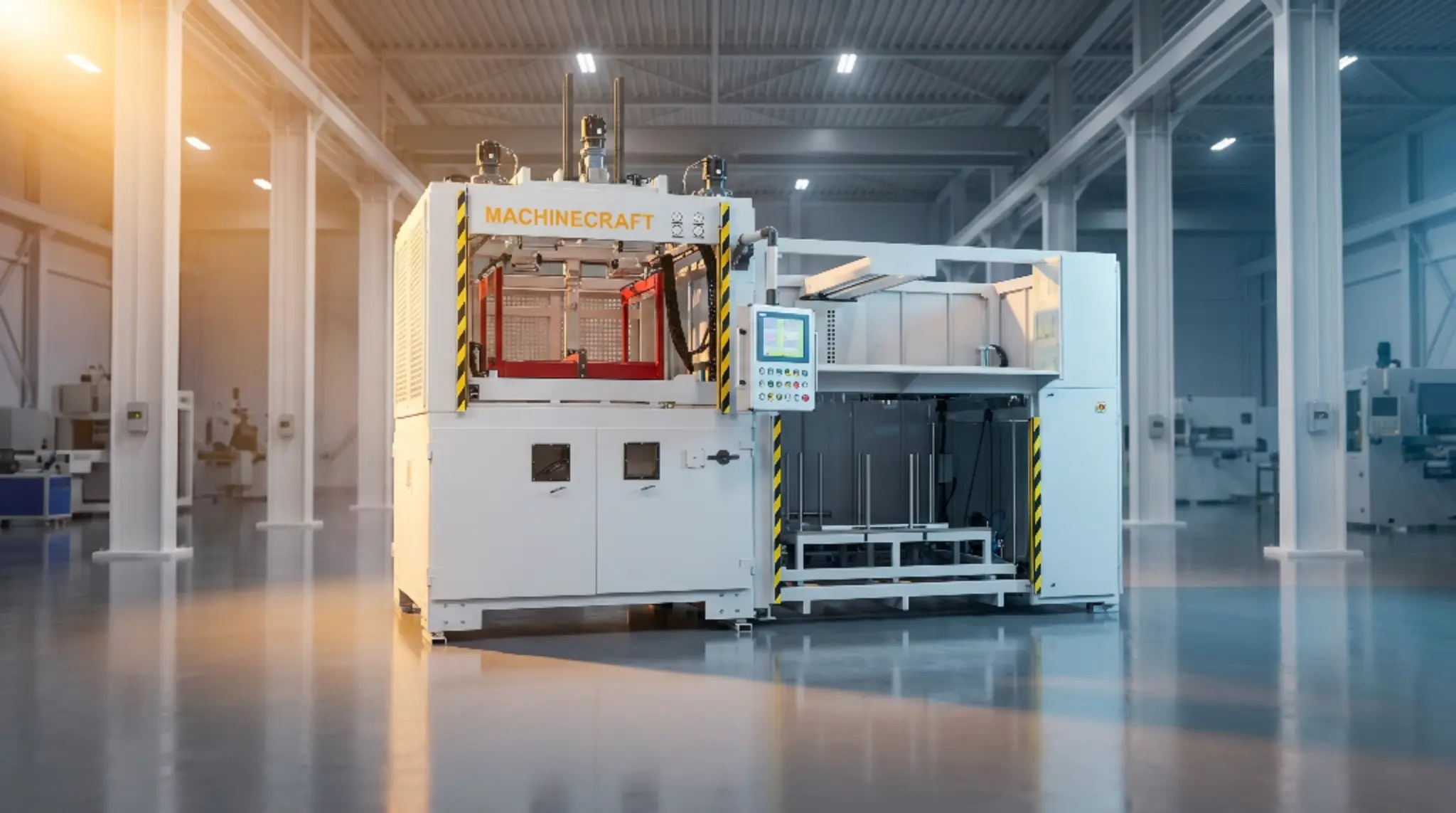
In a closed-chamber machine (Machinecraft PF1-X standard), the heater oven and the forming station are enclosed in a sealed chamber. Before forming, compressed air is blown into the chamber to create a pre-blow bubble — the heated sheet is inflated like a balloon before the mold contacts it. This pre-blow step is the key differentiator.
The fundamental challenge in thermoforming is achieving uniform wall thickness across a deep part. Without pre-blow, the sheet contacts the mold at the highest point first, and that area cools and stops stretching while the rest of the sheet is still being drawn. The result: thick walls at the top of the part, thin walls at the sides and corners. With pre-blow, the sheet is pre-stretched uniformly before mold contact, dramatically improving wall thickness distribution. For parts with draw ratios above 1:1 (depth greater than smallest plan dimension), pre-blow is essential for consistent quality.
In an open-frame machine, heat radiates from the heater elements into the ambient environment — significant energy waste. In a closed chamber, the heat is contained within the chamber, reducing energy loss by 20–30%. The chamber also allows the sheet to be heated more uniformly because there are no cold air currents disturbing the temperature field.
When large sheets of thermoplastic are heated to forming temperature, they sag under gravity. In an open-frame machine, this sag can cause the sheet to contact the mold prematurely, creating defects. In a closed-chamber machine, the pre-blow air pressure supports the sheet from below, preventing sag. This is critical for large sheets (above 1,500×1,000mm) and for materials with a narrow forming window (PMMA, PC).
Open-frame machines are appropriate for: simple shallow parts (draw ratio below 0.5:1), materials that don't sag significantly (thick HDPE, PP), budget-constrained applications where forming quality requirements are moderate, and applications where the machine will be used for a limited range of simple parts.
All Machinecraft PF1-X Series machines are closed-chamber as standard. The PF1-C Classic is open-frame. If you're producing parts with draw ratios above 0.5:1, processing PMMA or PC, or running large sheets above 1,500mm, closed-chamber is strongly recommended. The choice should be based on your material, part geometry and production requirements, supported by trials and a configuration-specific quotation.
Browse all archive entries