Archive entry · Feb 5, 2025
Historical content; not current machine specifications or a production guarantee.
Pickup truck bedliners are one of the highest-margin thermoforming products in the US market. This guide covers machine sizing, material selection, tooling, and production economics.
The USA is the world\'s largest pickup truck market — over 3 million trucks sold annually. The best-selling pickup truck has dominated US sales for over 40 consecutive years. Every truck is a potential bedliner customer, and thermoformed HDPE drop-in bedliners are one of the highest-margin products in the automotive accessories market. This guide covers everything you need to know about setting up bedliner production.
High-density polyethylene (HDPE) is the material of choice for drop-in truck bedliners for several reasons: (1) Impact resistance — HDPE absorbs impacts without cracking or shattering. (2) Chemical resistance — resistant to fuel, oil, and common cargo chemicals. (3) UV stability — with appropriate additives, HDPE maintains colour and integrity in outdoor use. (4) Thermoformability — HDPE forms well at relatively low temperatures and is forgiving to process. (5) Cost — HDPE sheet is widely available from US domestic suppliers at competitive prices.
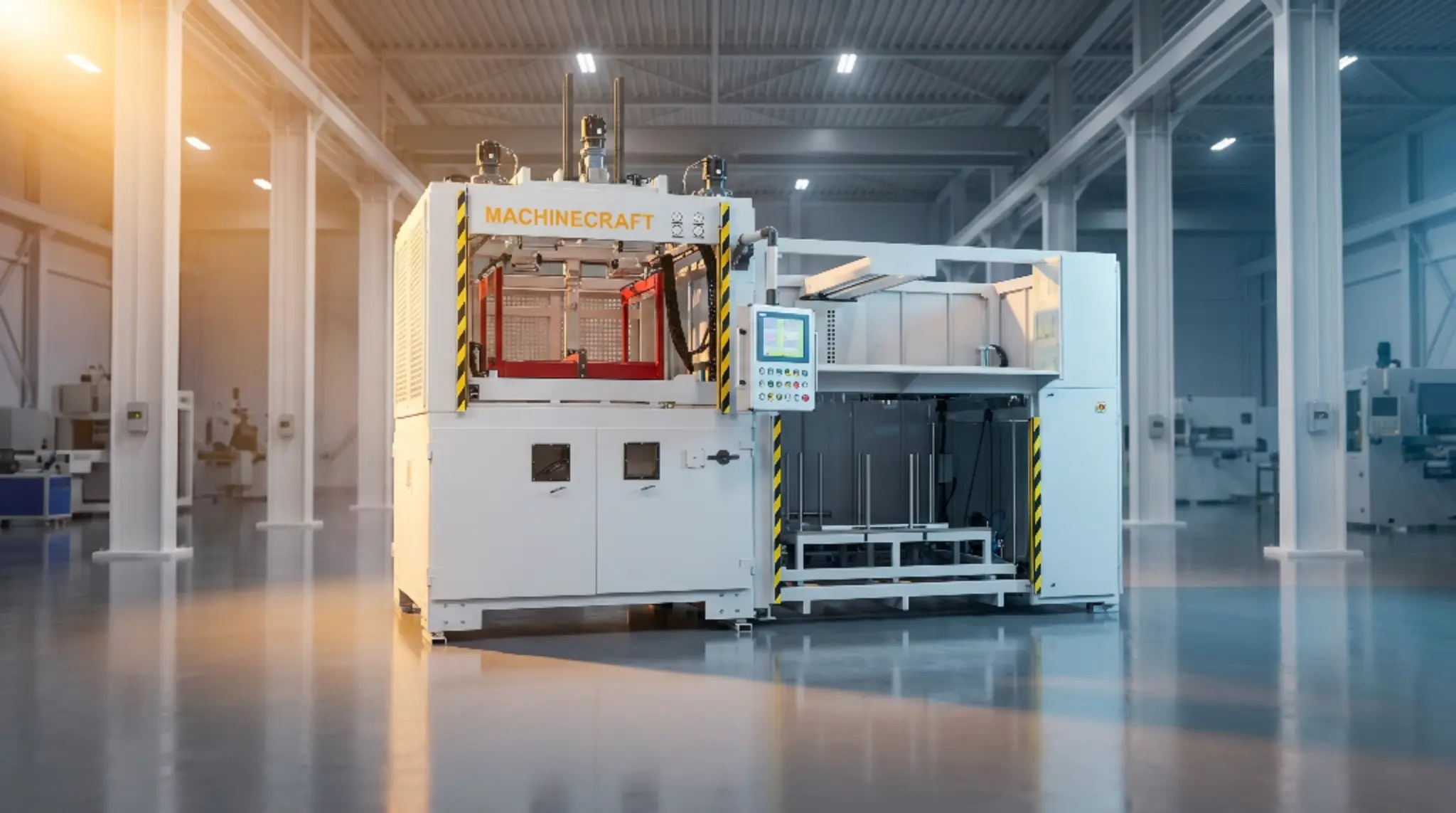
A full-size pickup truck bedliner (F-150, Silverado, Ram 1500) is approximately 72" × 48" × 8" (1830mm × 1220mm × 200mm). The forming area of the machine must be larger than the part to allow for material clamping — typically 10–15% larger on each dimension. For a full-size bedliner, a machine with a minimum 1500mm × 2000mm forming area is required. The PF1-X-1520 (1500 × 2000mm forming area, 300mm draw depth) is the standard recommendation.
For mid-size trucks, a PF1-X-1210 (1200 × 1000mm forming area) is typically sufficient.
Typical HDPE bedliner thickness is 6–8mm (0.25"–0.31"). This is heavy-gauge thermoforming — the machine must have sufficient heating capacity and clamping force for thick HDPE sheet. Halogen IR heaters are recommended for HDPE because they heat the material faster and more evenly than ceramic elements, reducing cycle time and improving surface quality.
Bedliner tooling is relatively simple — a single-cavity mold representing the truck bed interior. Aluminium is the preferred tooling material for production runs — it conducts heat well, machines easily, and lasts for 50,000+ cycles. Composite tooling is an option for lower volumes or prototyping. Tooling lead time is typically 6–10 weeks from a qualified toolmaker.
Build the production case from your own cycle, labor, material, trimming, quality, and sales inputs. Review part cost and contribution using your actual operating data; the selected machine scope and price are confirmed in a formal quotation.
The key steps to starting bedliner production: (1) Identify your target truck models and confirm the forming area requirements. (2) Source HDPE sheet from a US domestic supplier — get samples for forming trials. (3) Commission tooling from a qualified thermoforming toolmaker. (4) Order the machine with 480V/60Hz configuration and specify the material thickness range. (5) Plan your trimming cell — bedliners require trimming after forming, either by CNC router or hand trimming.
Browse all archive entries